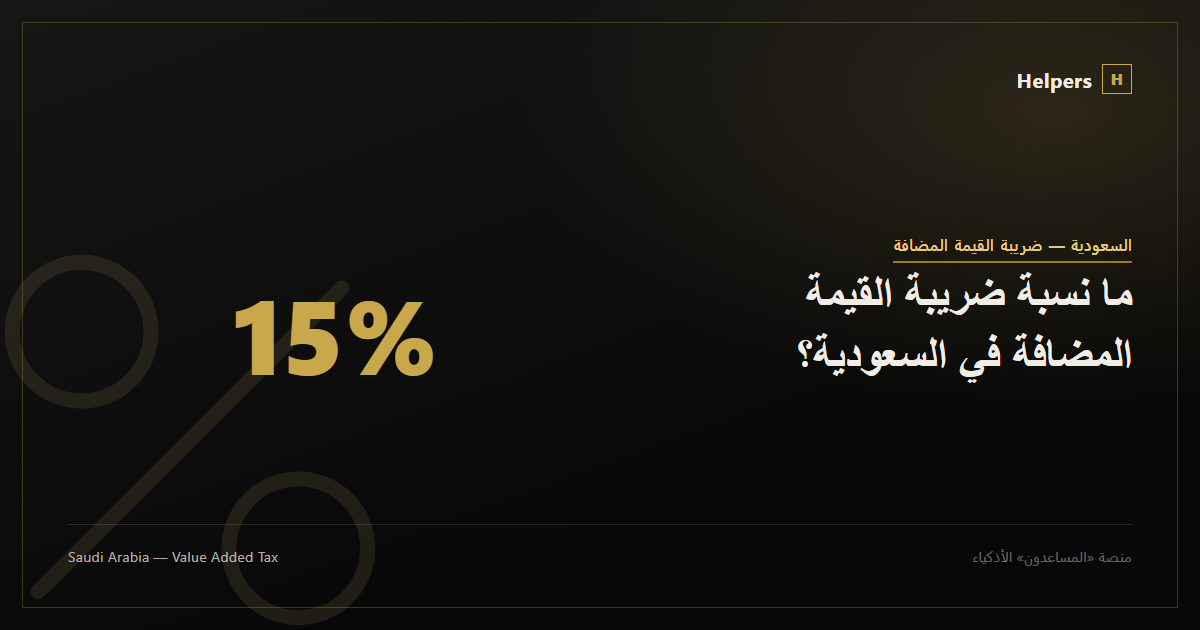
Saudi Arabia applies a standard Value Added Tax rate of 15% on the value of a supply or import, unless the supply itself is exempt or subject to the zero rate, in accordance with the Value Added Tax Law and its Implementing Regulations.
The Standard Tax Rate
The VAT Law provides that Tax is imposed on the import and supply of goods and services in accordance with the provisions of the Unified VAT Agreement of the GCC states, the Law and its Implementing Regulations, and that Tax is applied at a standard rate of 15% of the value of the supply or import, following the amendment made to Article Two of the Law pursuant to Royal Order No. (A/638) dated 15/10/1441H.
Exempt Supplies
The VAT Law states that the Implementing Regulations determine the supplies exempt from Tax and the supplies subject to the zero rate, along with the conditions and controls for that. Among the exempt supplies set out in the Implementing Regulations are:
- Financial Services listed in the Regulations, which are exempt from VAT except where the consideration for the service is an explicit fee, commission or commercial discount.
- The supply of residential real estate through lease or license, in addition to the supply of any real estate (commercial, residential, agricultural, or bare land) through transfer of ownership or the right to dispose of it as an owner.
Zero-Rated Supplies
Conversely, the Implementing Regulations subject certain specific categories of supplies to the zero rate rather than exemption, including for example:
- The international transport of goods, and the international transport of passengers by a qualifying means of transport or by a scheduled flight or voyage running according to a published timetable.
- The supply of Qualifying Medicines and Qualifying Medical Goods, in accordance with the classifications issued by the Ministry of Health or the competent authority.
The practical difference between exemption and the zero rate is that a zero-rated supply remains, legally, a "taxable" supply, which allows the person making it to deduct the related input tax, unlike an exempt supply, which does not entitle its supplier to that deduction.
Illustrative Example
Assuming a taxable person supplies goods worth SAR 1,000 exclusive of Tax, and this supply is subject to the standard rate, the Tax due is calculated as follows: SAR 1,000 x 15% = SAR 150, making the total value on the Tax Invoice SAR 1,150 inclusive of Tax. If the same supply were instead classified among the zero-rated supplies, the Tax due on it would be zero, even though it remains a taxable supply as a matter of law.
Legal References
- Value Added Tax Law — Article Two (as amended by Royal Order No. A/638) and Article Ten.
- IMPLEMENTING REGULATIONS OF THE VALUE ADDED TAX LAW — Article 29 (exempt Financial Services), Article 30 (lease of residential real estate), Article 34 (international transport), and the Article on Qualifying Medicines and Medical Goods.
- 1Second Version| May 2026 Guideline — the section on the standard 15% rate and the zero rate.
For questions about your specific situation, you can ask the Saudi Arabia Tax & Legislation Helper on Helpers, or consult a licensed chartered accountant.