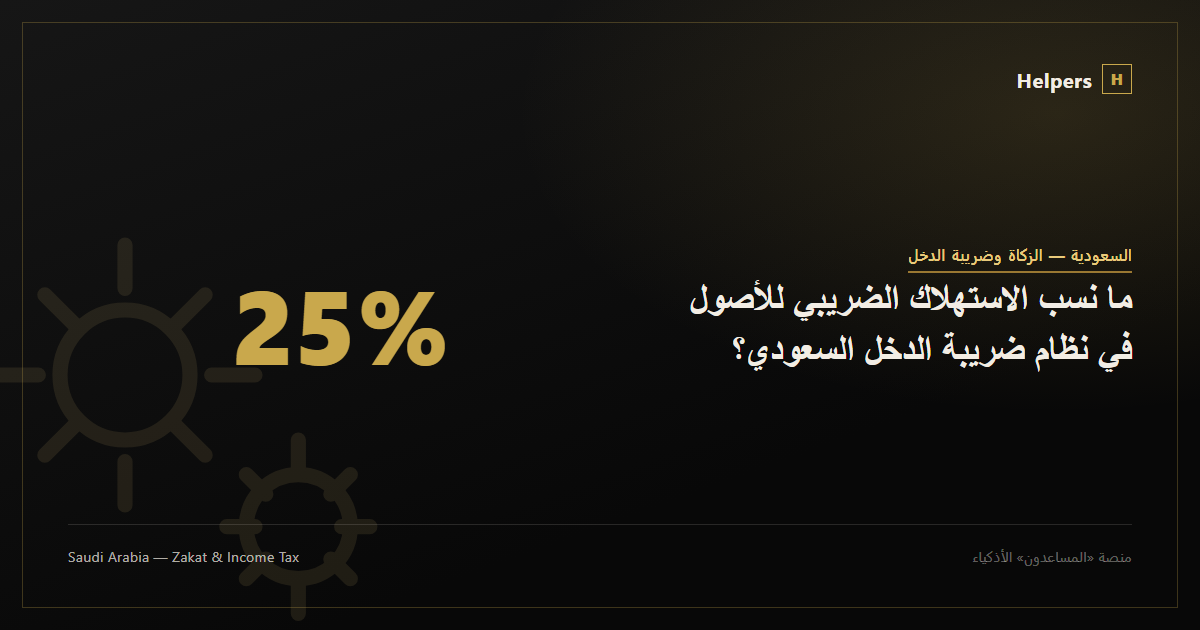
The Saudi Income Tax Law divides depreciable assets into five groups, with annual depreciation rates ranging between 5% and 25%, deducted on the declining balance of each group at the end of the tax year.
Assets Covered by Depreciation and the Excluded Land
Except for land, depreciation may be deducted on a taxpayer's tangible and intangible depreciable assets whose value decreases through use, wear, or obsolescence, that are used wholly or partly in producing taxable income, and that retain value after the end of the tax year. Land, however, is never depreciated for tax purposes, however long it is used.
Depreciation Rates by Asset Group
- Permanent buildings: 5%.
- Movable industrial and agricultural buildings: 10%.
- Factories, machinery, equipment, devices, software, and equipment, including passenger and freight vehicles: 25%.
- Geological survey, drilling, exploration, and preliminary work expenses for the extraction of natural resources and the development of their fields: 20%.
- All other tangible and intangible depreciable assets not included in the previous groups, such as furniture, aircraft, ships, locomotives, and goodwill: 10%.
How the Depreciation Instalment Is Computed
The depreciation instalment for each group is computed by applying the depreciation rate set for it to the remaining value of that group at the end of the tax year, that is, on a declining-balance basis rather than on the asset's original cost.
Deducting Small Balances and Improvements
If the remaining value of a group at the end of the year, after allowed deductions, is less than one thousand (1000) Riyals, that remaining value may be deducted in full. Repair and improvement expenses on a group's assets may also be deducted, provided the allowed amount for the year does not exceed 4% of the group's remaining value at the end of that year.
What Happens If Repair Expenses Exceed the Allowed Limit?
If repair and improvement expenses exceed the amount allowed to be deducted in the year, the excess over that limit is added to the group's remaining value, to be depreciated in future years at that group's depreciation rate instead of being deducted all at once.
Why Do Depreciation Rates Differ Between Groups?
The variation in depreciation rates between asset groups reflects the nature of each asset and its economic useful life; permanent buildings depreciate relatively slowly at 5% given their long productive life, while machinery, equipment, and software depreciate faster at 25% given their more rapid technical obsolescence. Understanding this classification is therefore important when planning investment in fixed assets and estimating the tax impact of each type.
Legal References
- Income Tax Law, Article Seventeen and Article Eighteen.
For questions about your specific situation, you can ask the Saudi Arabia Tax & Legislation Helper on Helpers, or consult a licensed chartered accountant.