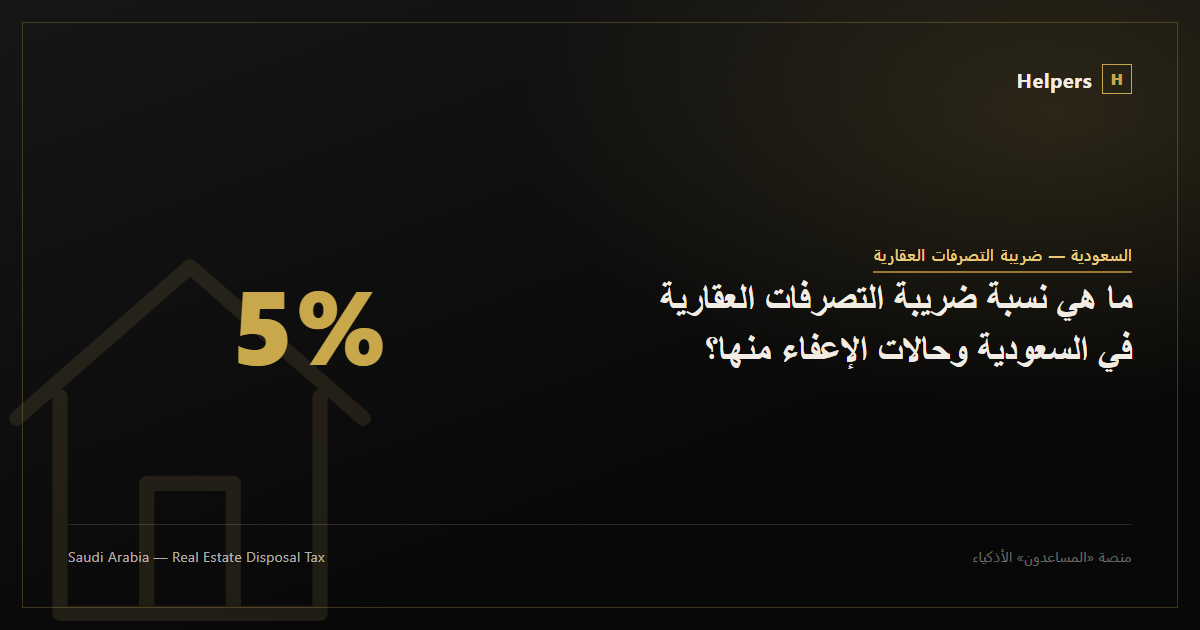
Saudi Arabia's Real Estate Disposal Tax (RETT) is levied at 5% on any real estate transaction, regardless of the condition or use of the property at the time of the transaction, and whether or not the transaction is documented. The transferor is responsible for paying the tax, and the Law sets out a specific, exclusive list of exemptions. This tax replaces VAT liability on the real estate supplies it covers, since those supplies are exempted from VAT to avoid double taxation on the same real estate transaction.
Tax Rate and Calculation Base
The tax is imposed at a rate of 5% on the real estate transaction, regardless of the condition, form, or use of the property at the time of the transaction, and whether the transaction covers the whole property or part of it, a divided or undivided share, and whether the property is completed, under construction, or off-plan. The tax is calculated based on the total value of the transaction agreed between the transferor and the transferee, provided it is within the limits of the fair market value at the date of the transaction.
When Is the Tax Due and Who Pays It?
The tax becomes due on the date of the real estate transaction, which is deemed by law to be the date of its documentation. The transferor is responsible for the tax due and must pay it to the Authority in accordance with the procedures and deadlines specified by the Regulations, while the transferee is jointly liable in cases where it is proven that they caused the tax not to be paid.
Key Exemptions
A number of real estate transactions are exclusively exempted from the tax under the Law, most notably:
- Real estate transactions in cases of inheritance division.
- Real estate transactions without consideration to a public, private, or joint waqf, or to or from a licensed charity.
- Real estate transactions to a public entity, any public legal person, or public-benefit bodies or projects.
- Real estate transactions to a spouse or any relative up to the third degree, by way of a documented gift.
- Real estate transactions in cases of public subscription, trading of listed securities, and trading of investment fund units.
- A transaction transferring property to a real estate developer licensed to sell and lease off-plan, provided the property is designated for an off-plan sale project with a licensing decision from the competent authority.
- A real estate transaction carried out pursuant to a compulsory sale order issued by a competent court.
- A real estate transaction resulting from merger and acquisition transactions between legal persons.
- Returning the transferred property to its previous owner as a result of rescinding the documented transaction by mutual consent of its parties, within a period not exceeding 90 days from the date the rescinded transaction was documented, provided no change occurs to the description of the property and its full value is returned.
The Authority's Power to Review the Value
The Authority may, within a period not exceeding 3 years from the date of the transaction, verify the disclosed value of the real estate transaction, and must recalculate the tax due in cases where it is proven that the disclosed value is less than the fair market value, including cases of tax evasion. Within the same period, the Authority must also estimate the value of an undervalued real estate transaction and calculate the tax due on an undocumented transaction or one not disclosed to it.
Illustrative Example
As a hypothetical example, if the fair market value of a transferred property is 1,000,000 riyals, the tax due is calculated at 5% of that value, i.e. 50,000 riyals (illustrative example with assumed figures).
Legal References
- Real Estate Disposal Tax Law (1446H) — Articles 2, 3, 4, 7, and 8.
For questions about your specific situation, you can ask the Saudi Arabia Tax & Legislation Helper on Helpers, or consult a licensed chartered accountant.