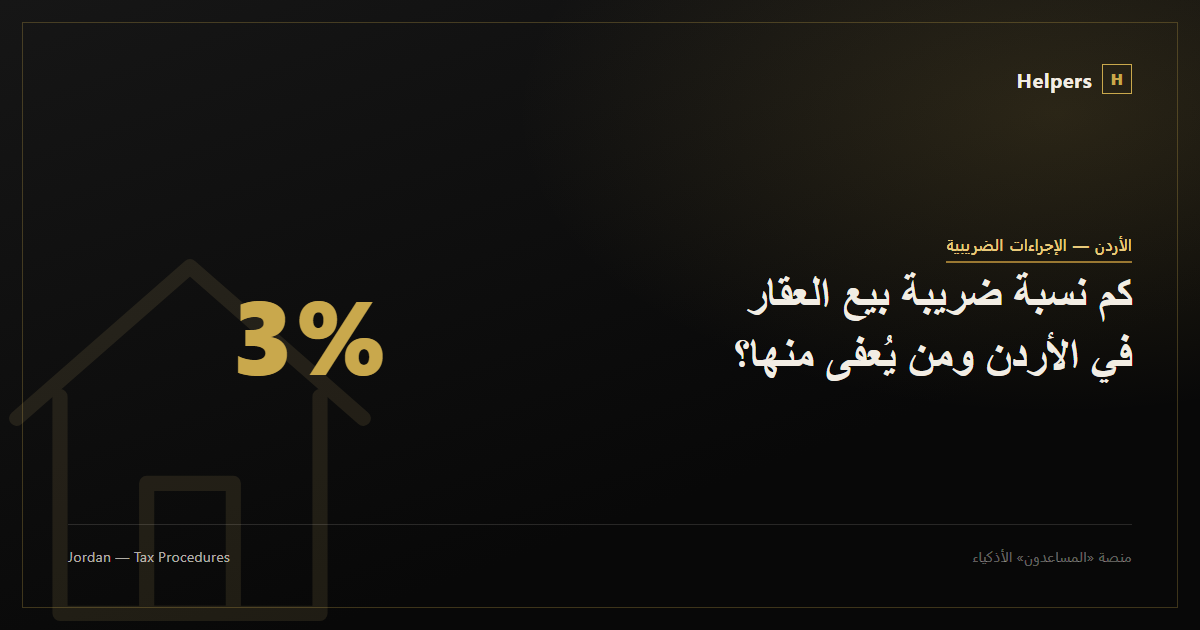
When any property is sold in Jordan, the land registration departments collect a tax of 3% of the amount on which the registration fee is based; exempted from this tax are sale and gift contracts between ancestors and descendants, siblings, and spouses, in addition to other cases specified by law.
What is subject to the real estate sale tax?
The concept of a sale under this law includes a consensual sale contract, and also covers a disposal ("ifraagh") and a gift. The definition of property covers land and the trees and permanent installations on it, including wells, as well as a building or any apartment, floor, or roof of it.
The tax rate and its basis
When any property is sold, the land registration departments collect from the seller or donor a tax of 3% of the amount on which the registration fee is based.
Illustrative example
- Suppose a property's registration fee is calculated on an amount of 100,000 dinars; the real estate sale tax due from the seller or donor would then equal 3,000 dinars (3% of 100,000 dinars). These are hypothetical figures for illustration only.
Cases exempted from the tax
The law exempts several cases from its provisions, including sale, disposal, and gift contracts between ancestors and descendants up to the third degree, between brothers and sisters, and between spouses; sale contracts between the Housing and Urban Development Corporation and the beneficiaries of its projects and between housing cooperative societies and their members; sale contracts between banks and companies for individual housing projects financed without interest and their beneficiaries; and contracts for the free transfer of immovable property made in the name of the Treasury or any government institution or a municipal or village council originally exempt from land registration fees, provided the transfer serves a specified public purpose. Also exempted are subsequent sale transactions under Murabaha property sale contracts carried out by Islamic banks and financial institutions engaged in Murabaha business, within sixty days from the date the bank or financial institution acquired the property.
Refunding the tax for incomplete transactions
Real estate sale tax already collected is refunded to those who paid it for transactions whose procedures were not completed, after deducting the administrative cost of the transaction under the regulation on administrative costs for services provided by the Land and Survey Department. This law repealed the 1973 Capital Gains Tax Law, while that law's provisions remain in force for transactions that were objected to and not decided upon before this law took effect.
Legal References
- Real Estate Sale Tax Law No. 21 of 1974 — Article 2 (definition of sale and property)
- Real Estate Sale Tax Law No. 21 of 1974 — Article 3 (3% tax rate)
- Real Estate Sale Tax Law No. 21 of 1974 — Article 4 (exempted cases)
- Real Estate Sale Tax Law No. 21 of 1974 — Articles 5 and 6 (tax refund and repeal of the Capital Gains Tax Law)
For questions about your specific situation, you can ask the Jordan Tax & Legislation Helper on Helpers, or consult a licensed chartered accountant.